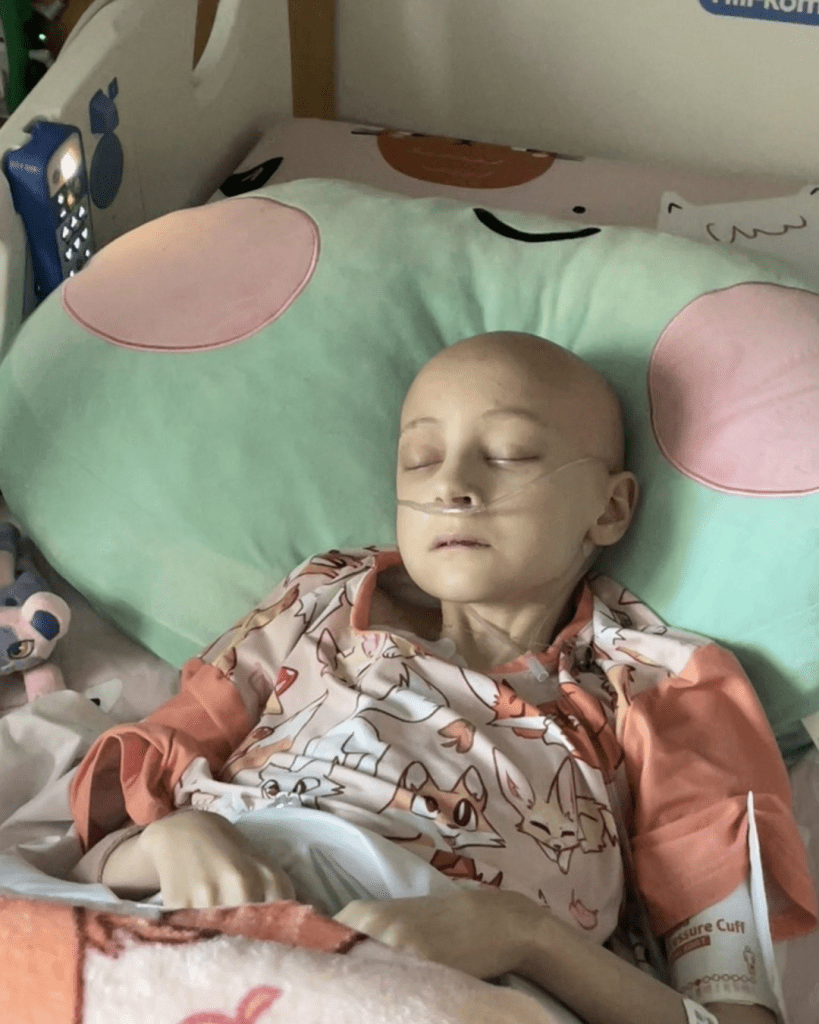
This is the face of childhood cancer.
It is not rare. It is not okay. And it is certainly not something we can afford to turn away from.
Childhood cancer is the leading cause of death by disease in children in the United States. That fact alone should stop us in our tracks.
But numbers and statistics only scratch the surface. They cannot capture the reality of what this disease looks like in the life of a child, in the heart of a parent, in the daily rhythm of a family that never asked for this battle.

When we think of 13-year-olds, we should picture laughter ringing through school hallways.
We should picture sleepovers and soccer games, birthday parties and silly arguments about nothing.
We should picture a teenager sprawled on the couch with friends, watching movies and laughing until their stomach hurts.
But for too many children, that is not reality.

Instead, cancer rewrites the script. A 13-year-old may find themselves clenching in pain, their body aching from tumors or side effects of chemotherapy.
Instead of sitting in a classroom, they are lying in a hospital bed. Instead of planning weekends with friends, they are waiting for lab results. Instead of worrying about homework, they are worried about survival.
This is what childhood cancer really looks like.

It looks like tears streaming down a face too young to carry this much pain. It looks like exhaustion from endless nights in sterile hospital rooms where the beeping of monitors replaces the comfort of quiet sleep.
It looks like a body weakened by treatments so toxic they would bring many adults to their knees. It looks like moments no child should ever have to endure — surgeries, spinal taps, infusions, radiation burns.
It looks like parents holding back tears in front of their child, whispering prayers they never thought they would have to say.

It looks like siblings trying to understand why their brother or sister can’t come home, why holidays and birthdays now happen under fluorescent lights instead of at the kitchen table.
It is not rare. But because it happens behind hospital doors, many people never see it.
And that invisibility becomes part of the problem. If we do not see it, if we do not speak about it, then it is far too easy to accept it as “just how it is.”
But it is not acceptable. It cannot be acceptable.

Because our kids deserve better.
Right now, only about 4% of federal cancer research funding in the United States is directed toward childhood cancers. Four percent.
Four percent to fight the number one disease-related killer of children. Four percent to protect the most vulnerable among us.
Imagine if your child’s school received 4% of the resources it needed.
Imagine if your community’s fire department was given 4% of its funding and expected to keep everyone safe.

Imagine if your family lived on 4% of its income. Would anyone say that was enough? Of course not. And yet, this is the reality families of children with cancer face every single day.
Children are not just small adults. Their bodies are different. Their cancers are different. Their needs are different.
Treatments designed for adults are often too harsh, too damaging, and not specifically effective for pediatric cancers. And yet, because of limited funding, most children are treated with drugs developed decades ago.

Drugs that may keep them alive, but often leave lasting scars — heart damage, infertility, secondary cancers, cognitive struggles. Survivorship, for many, means a lifetime of consequences.
So when we say children deserve more than 4%, we mean they deserve more research, more targeted therapies, more hope. They deserve treatments that not only save their lives but protect the futures they are fighting so hard to reach.
We cannot continue to look away.

We cannot continue to tell parents, “This is just how it is.” We cannot let children grow up thinking their lives are worth less than better treatments, worth less than breakthroughs that should already be within our reach.
Behind every statistic is a child. A child with a name, a laugh, a favorite color, a dream for the future.
A child who loves superheroes and animals, who wants to be a teacher or a doctor or a pilot someday. A child who should be running through sprinklers in the summer, not hooked up to IV lines.

Behind every number is a family. A mother who would give anything to trade places. A father who feels helpless when he cannot fix the pain.
Brothers and sisters who try to be strong but cry quietly at night. Grandparents who pray and hope and do everything they can, even when it never feels like enough.
This fight is not abstract. It is real. It is daily. It is brutal. And yet, in the middle of it all, children show us a kind of courage most adults will never know.
They face needles, surgeries, and treatments with resilience that humbles us.

They laugh even when their bodies hurt. They smile even when their days are filled with fear. They remind us what true strength looks like.
But courage alone is not enough. Faith alone is not enough.
Love alone is not enough. These children need us — all of us — to raise our voices, to demand change, to push for more research, more awareness, more funding.
They need us to believe that their lives are worth more than 4%.
Because they are.


This is the face of childhood cancer. Not rare. Not acceptable. And not something we can turn away from.
Our kids deserve better. They deserve hope that isn’t rationed. They deserve futures that aren’t stolen.
They deserve more than this. More than pain. More than exhaustion. More than 4%.
They deserve life — full, beautiful, unbroken life.
And it is our responsibility to fight until that is no longer a dream, but reality.