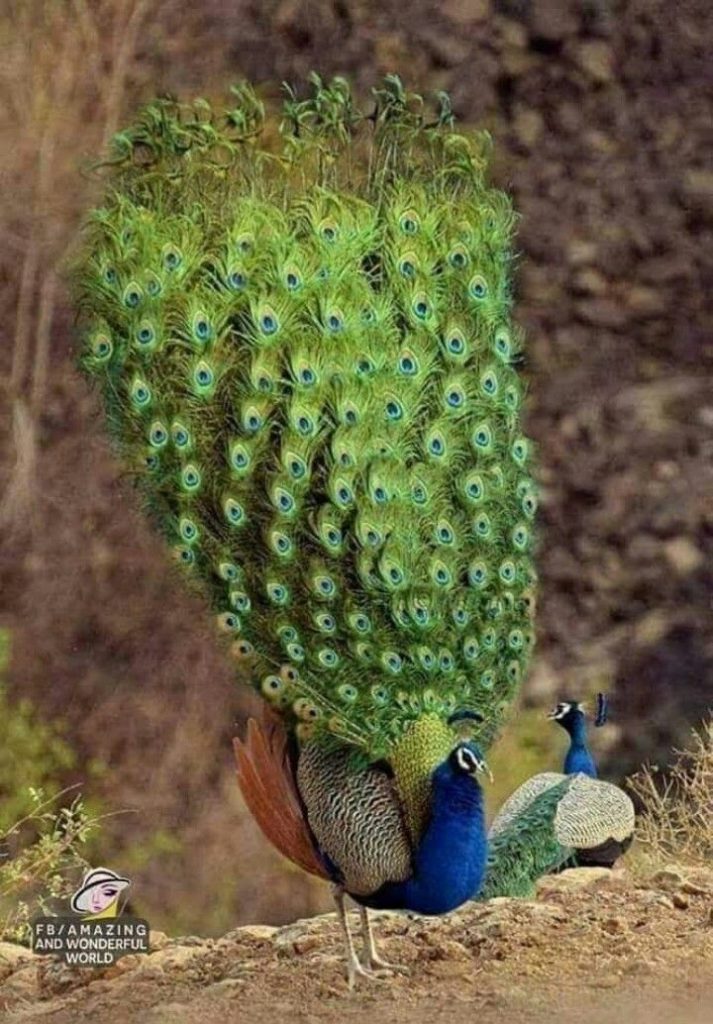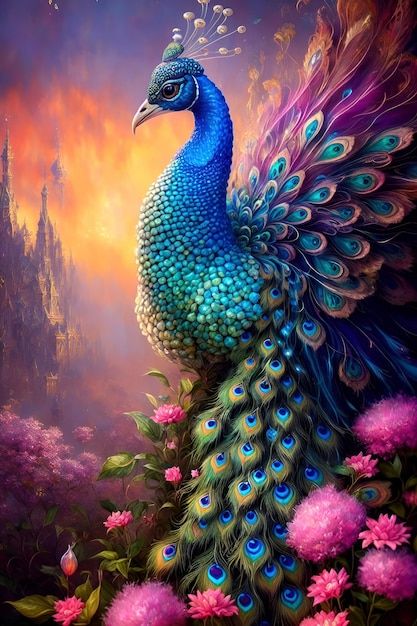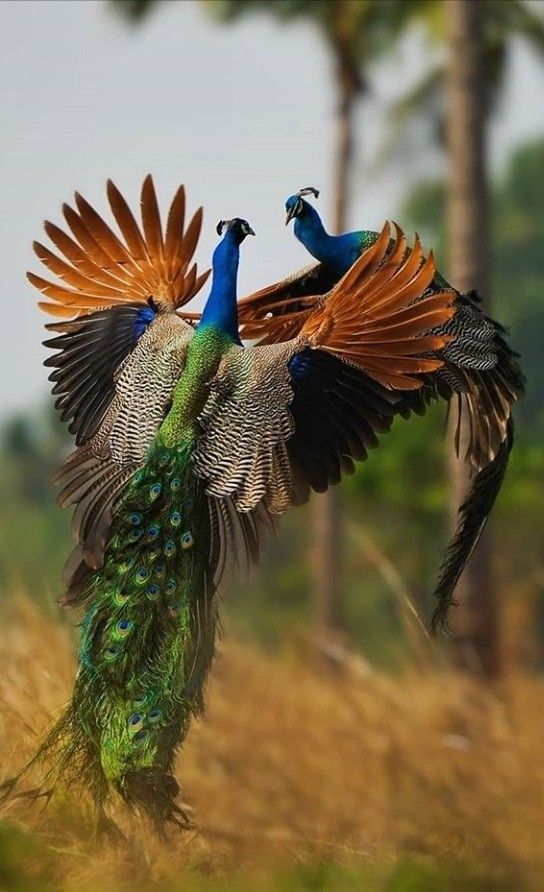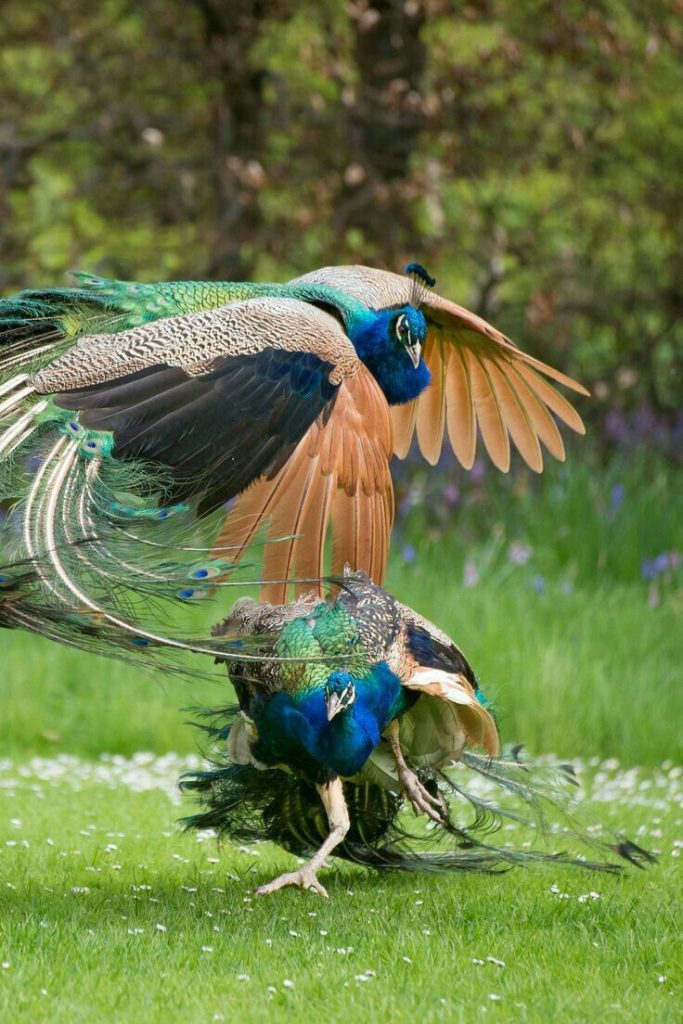
We humans have a love for bird feathers. We use them for an array of different products, but some bird feathers are desired simply for their colorful beauty. In fact, sometimes we love birds to death for their feathers. Thankfully, there are plenty of peacocks, which are raised domestically.
Their colors are a favorite for designers and just plain everyday people. I absolutely love the iridescent blue, green, and gold combination.
How about you?
Do you ever wonder why the feathers are colorfully eye-catching, and what makes them so?
Jian Zi, a Chinese scientist did.
National Geographic reports:
His motivation to study peacock coloration came after a trip to the marketplace in southern China’s Yunnan province, where he bought a bundle of peacock feathers from Banna (a town renowned for its wild peacocks) as a souvenir. “When I watched the eye pattern against the sunshine, I was amazed by the stunning beauty of the feathers,” said Zi.
That Gorgeous Color… is quite a cocky story – What’s Pigment Got To Do With It?
Apparently pigments don’t have much to do with it.
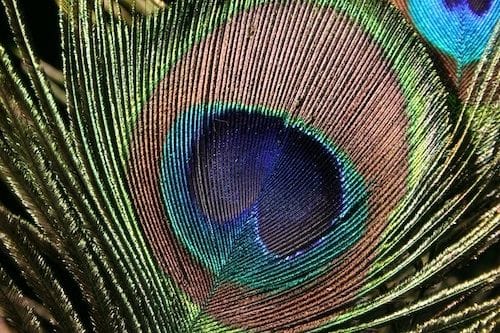
“The vivid colors of a peacock feather do not arise entirely from pigments – in fact, the role of pigments may be minimal. The structure of the feather plays a role in the color … there [are] structural arrays in the barbules of the peacock feather which were measurably different for the different colored regions. The barbules are described as straplike “twigs” which come off the branches of the peacock feather.
There are “subtle variations in color as well as areas which seem to “fire” with more reflected intensity than neighboring regions. Iridescence in the colored regions is taken as evidence of color which is structural in its origin, as opposed to pigment color. ”
This structural effect which results in perceptions of colors are present in butterflies and in other bird feathers, as well.
Specifically:
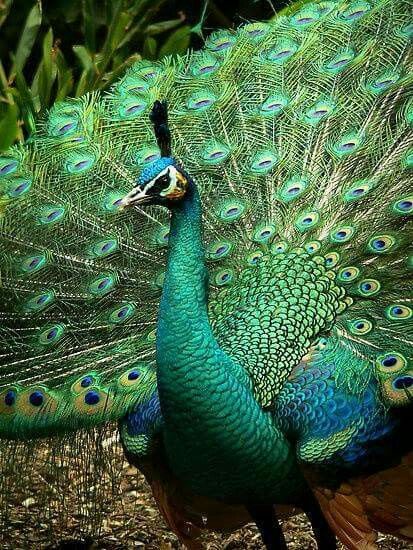
“When light shines on the feather, we see thousands of glimmering colored spots, each caused by minuscule bowl-shaped indentations. Stronger magnification reveals microscopic lamellae (thin plate-like layers) at the bottom of the indentations.”
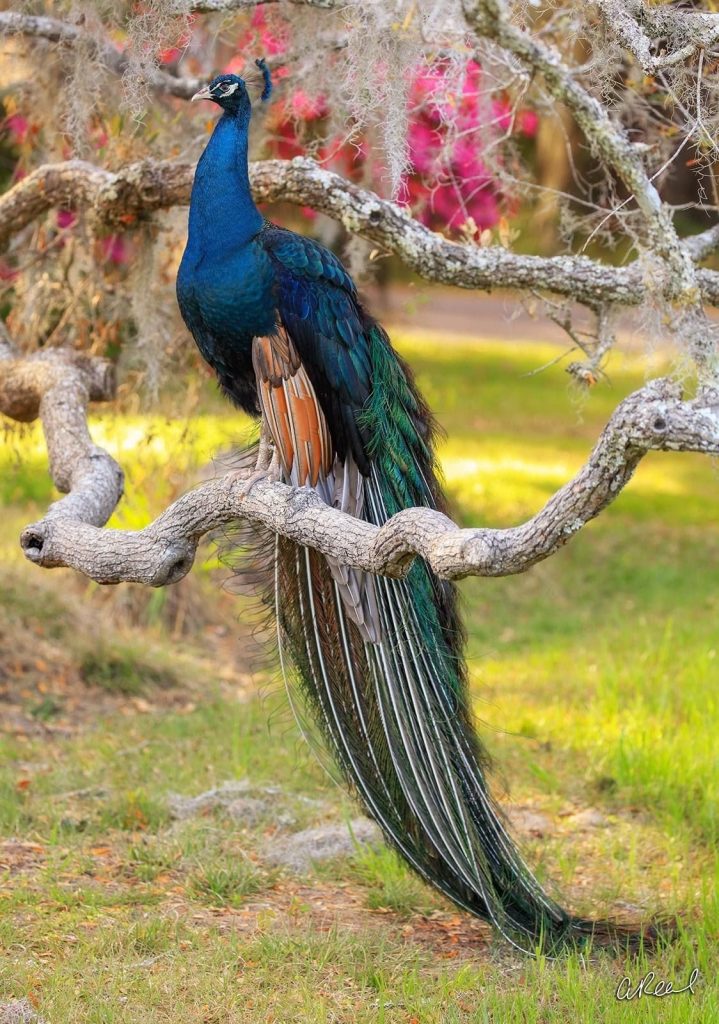
Another,simpler, way it is explained is that it is “a complex structure that changes color with the angle of incident light.” The photonic crystals are tiny, intricate two-dimensional crystal-like structures which make up the barbules. “Slight variations in the arrangement of keratin and melanin are responsible for the palette of colors found in the eye of a peacock’s tail feather. ..in peacock feathers, it is the precise structural array of melanin rods in keratin that creates different colors, with one array reflecting back yellow light, for example, and a slightly different arrangement reflecting back blue light.”-New York Times
So, except for the role of black, the colors which we perceive from looking at the peacock are created by the way the feathers catch and throw off light.
Sir Isaac Newton, in the 17th- and 18th-century, was among the first to hypothesize this structural basis for the colors, but it is only recently that Chinese scientists uncovered the full explanation.
I’m not sure I understand all the science involved, but the upstart of it is that pigments, which we usually think of as giving color, like in the human iris of the eye or in hair, has very little to do with the wonderfully bright and attractive colors of many birds and butterflies….and in this case the peacock’s feathers.
Jian Xi and his cohorts have their abstract online, if you want the discovery straight from the horses mouth.
The Secret Of Its Shimmer
Emerald and Sapphire – Jewel Colors
Nature holds a repeat performance when it comes to the jeweled sapphire blue and emerald green highlights found in some iridescence. When that isn’t enough, artists are more than glad to borrow this dramatic and unfailing way to attract the eye.
The colors in peacock feathers are vibrant and seem to shimmer.
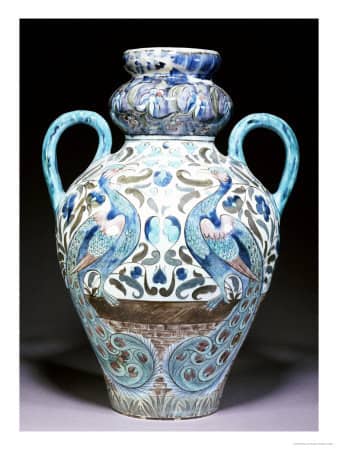
In Asia, the feathers of the peacock are considered lucky and protective.
The peacock is the male of a variety of the pheasant species, Pavo cristatus. The female is a peahen; both are known as peafowl. It is native to India and Sri Lanka.
Male peacocks shed and re-grow tail feathers each year.
With full plumage, peacocks can be as long as 7 feet from the tips of their beaks to the ends of their trains.
Origen and Augustine refer to peacocks as a symbol of the resurrection, but by the Middle ages the peacock stood for vanity.
The Symbolism
Symbolic meaning is roughly divided by Eastern and Weastern culture and by time periods. The Eastern and earliest symbolism being positive in nature, as well as connected to immortality or resurrection (some of the very early Christian identification of this symbol).
It is later that the peacock became an icon for the vain, and in most modern times is simply identified with beauty, although there is a vague impression still carrying the more negative shadow of the past.
The Fabled and Painted Peacock
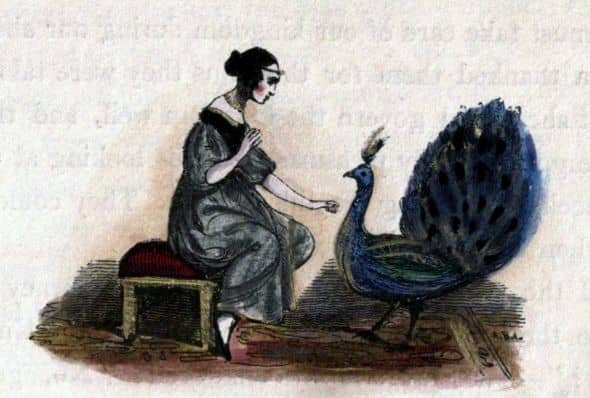
In Christian symbolism the peacock is often used as a symbol of vanity because of its beauty and the manner it displays the tail feathers. There are other meanings, but less known and more esoteric.
Saint Augustine associated peacocks with the resurrection, borrowing from earlier, Pagan, associations of the peacock with immortality.. In the Bible, an account of these birds being brought to Solomon by his ships from Tarshish (1 Kings 10:22; 2 Chr. 9:21) is recorded.
Babylonians and Persians regarded the peacock as the guardian of loyalty, and denoting royalty. Hindus considered them as good luck, other Asian cultures signify love and protection with them.
Real Life Peacock Dance Display