
The pink-necked green pigeon (Treron vernans) is a species of bird of the pigeon and dove family, Columbidae. It is a common species of Southeast Asia, found from Myanmar and Vietnam south through to the major islands of Indonesia and the Philippines (where it is called “punay”). It is a medium-sized pigeon with predominantly green plumage; only the male has the pink neck that gives the species its name.

The species lives in a wide range of forested and human-modified habitats and is particularly found in open habitats. Its diet is dominated by fruit, in particular figs. Pairs lay two eggs in a flimsy twig nest in a tree, shrub, or hedge, and work together to incubate the eggs and raise the chicks. The species is thought to be an important disperser of fruit seeds. The species has adapted well to human changes to the environment, and can be found in crowded cities as long as fruiting trees are present.

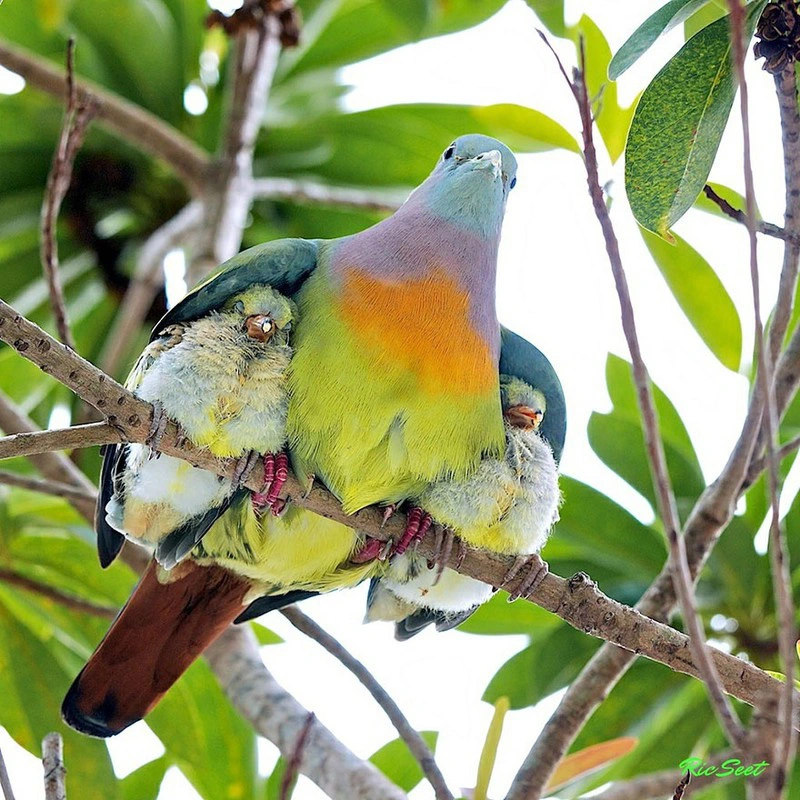
Description: The pink-necked green pigeon is a medium-sized pigeon, measuring 25 to 30 cm (9.8–11.8 in) in length and weighing around 105–160 g (3.7–5.6 oz). The species has sexually dimorphic plumage. The male has a grey head, pinkish neck and upper breast, and the rest of the breast is orange. The back is olive green and the wings are green with black primaries and yellow edging on the tertiaries which create a yellow bar across the wing in flight.
The belly is yellowish with grey flanks, and the tail is grey with a black band at the end, and a chestnut uppertail coverts. The female is smaller overall, has a yellowish belly, throat and face, and greenish crown and back of the neck, although is otherwise similar to the male. The legs are pink or reddish, and the bill is white, pale blue green or grey. Juvenile birds look similar to females but are greyer above.

Distribution and habitat: The range of the pink-necked green pigeon extends from southern Myanmar, Thailand, Cambodia, and Vietnam south through the Malay Peninsula and across the Greater Sundas (and their surrounding islands), Bali, Lombok, Sumbawa, and as far east as the Moluccas as well as the Philippines. It occupies a variety of habitats, including primary forest, forest edge, secondary forest, and coastal mangroves.It favours more open environments and where it is found in association with denser forest it is typically on the edges.
It is also readily found in human dominated environments such as gardens, plantations and farmland. It is more common in lowlands and close to the coast, but can be found up to 300 m (980 ft) in the Philippines, 750 m (2,460 ft) in Borneo and 1,200 m (3,900 ft) in Sulawesi. The species is recorded as non-migratory by the Handbook of the Birds of the World,but other sources have described it as making local movements.A related species, the thick-billed green pigeon, covers vast distances in search of fruit, and it is likely that the pink-necked green pigeon has a similar behaviour.

Behaviour: The pink-necked green pigeon is primarily a frugivore, taking a range of fruits, particularly figs (Ficus). Fruit of other trees are taken as well, including Glochidion, Breynia, Vitex, Macaranga, Muntingia, Melastoma, Oncosperma and Bridelia.Shoots, buds and seeds are also taken, but much less commonly so, often by quite a substantial margin. In one study of the frugivores of Sulawesi 55 observations were made of this species feeding and every one was of it eating fruit, mostly figs.

The species feeds in the mid-canopy of the forest and rarely feeds in the understory or on the ground. It is described as being agile when clinging on fine branches to reach fruits at the end.Like other members of the genus Treron, the gizzard is muscular and contains grit, which is used to grind and digest seeds inside fruit. Studies of closely related species have found that not every individual has grit, and it is likely the same is true of this species.It is social, feeding in small groups or, where an abundant source of food is found, quite large flocks of up to 70 birds. The species also roosts communally, and can form roosting flocks of hundreds of birds.
Status: An adaptable species, T. vernans has fared well with human-made changes to its range. It has readily moved into cities and is common in Singapore’s protected areas and even its gardens and has become more common over time.In spite of suffering some hunting pressure in Thailand, Malaysia and Sumatra,and being targeted by the cage bird trade,it remains common there and across most of its range.Because it is not considered to be in any danger of extinction it has been evaluated as least concern by the IUCN Red List of Threatened Species.
Video: