The beginning of the week felt ordinary.
A small stomach bug had made its way into the house.
Cooper, Bowen’s five-year-old brother, had been the first to catch it.
For about forty-eight hours, he was miserable—vomiting, weak, tired—but eventually, he bounced back.
We all breathed a sigh of relief when it passed.

So when Bowen started throwing up on Wednesday night into Thursday, we assumed the same thing.
Another stomach virus, passed from one brother to the other.
We were prepared for a rough two days, maybe three.
It never crossed our minds that it could be something so much more.

But by Saturday morning, things didn’t look right.
Bowen still couldn’t keep anything down.
His little body was growing pale, his lips dry, and I could see the signs of dehydration beginning to take hold.
Still, my mind clung to the explanation that he was just sick.
I noticed his pulses were weak and sometimes slowed.
At first, I told myself this was because he was depleted, maybe from not eating or drinking enough.
But deep down, something didn’t feel right.

We decided to take him to urgent care.
It was a Saturday morning, and thankfully, the waiting room wasn’t too crowded.
Within minutes, they had him hooked up to a monitor.
That’s when everything shifted.
The monitor showed that Bowen was having intermittent bradycardia.
His heart rate was dropping.
At times, he was on the verge of losing consciousness.

The room changed instantly from calm to critical.
Nurses and doctors were moving quickly.
They were giving him epinephrine, performing chest compressions, keeping him alive moment by moment.
My heart raced as I watched them fight for him.
The helicopter was called, but the weather was bad, and it was too far.
That left us with an ambulance ride, rushing through awful traffic on 75, sirens blaring, every second feeling like an eternity.

I work at the children’s hospital we were heading to.
The other nurses who knew me were wracking their brains, trying to think of what could be causing this.
His bloodwork came back normal, which made it even more confusing.
It wasn’t sepsis.
It wasn’t anything that lined up cleanly with what they were seeing.
They worried he might have ingested something we didn’t notice, but even that didn’t match the way he was presenting.

When we finally arrived, they took him straight into a trauma bay.
Even there, they were still fighting to stabilize him.
He was fading, and every ounce of energy went into keeping him alive.
The doctor and I had a quick, sobering discussion.
We needed answers.
So we decided to run a head CT, just to rule out anything we hadn’t thought of—unwitnessed trauma, some hidden problem.
It was supposed to be just another box to check.

But then they saw it.
I will never forget that moment.
The doctor sat me down, and with eyes full of compassion but heavy with truth, he told me what they had found.
There are no words to describe the way my heart shattered.
I looked at my beautiful, perfect baby lying on that table, wires and monitors everywhere, and nothing in the world could have prepared me for that.

They were already getting ready to intubate him.
Plans were forming quickly—rushing him into surgery to decompress his skull, trying to relieve the pressure before it stole more of him from us.
And somehow, in the middle of the chaos, I had to tell Josh.
I had to tell our family.
I had to put into words what I didn’t even want to believe myself.

His neurosurgeon examined the scans and quickly identified what he believed the tumor to be.
Choroid plexus.
There were two possibilities: a benign papilloma or a carcinoma.
Even then, he leaned toward carcinoma.
But labels and technical terms faded in my mind; all I could see was my little boy, about to face the fight of his life.

They stabilized him enough to take him into surgery.
Nine hours.
That’s how long the neurosurgeon and his team worked, meticulously removing the tumor.
Nine hours of prayers whispered in waiting rooms.
Nine hours of fear and hope battling inside me.

These tumors are known to be extremely vascular.
Often, it isn’t possible to remove them completely.
But somehow, by skill and miracle, the surgeon was able to resect the entire tumor.
Every last piece.
An outcome we hadn’t dared to hope for.
When he came out, the surgeon told us again what he believed: this looked like CPC, carcinoma, not CPP, the benign form.
It was sobering, but at that moment, all I could hold onto was the victory of the surgery.
My baby was alive.
The tumor was out.
We had a chance.
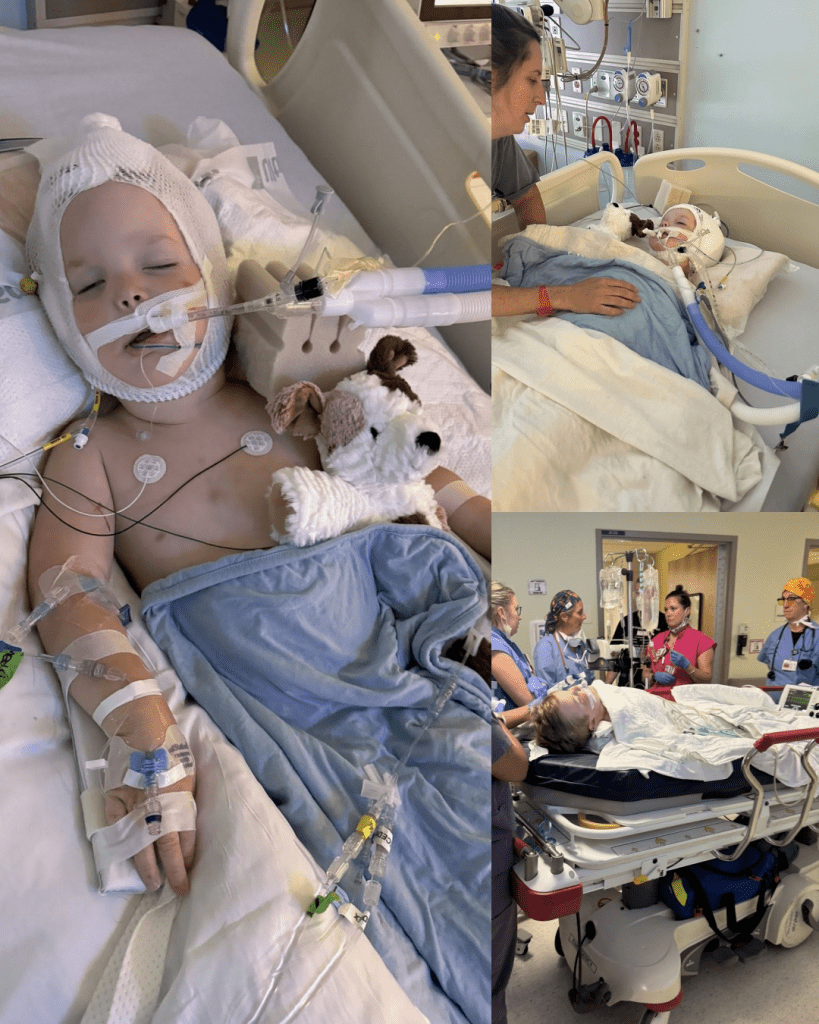
Bowen spent the next week in the PICU.
Every beep of the machines, every nurse who walked in, every careful step forward was part of his recovery.
We held his hand, whispered encouragement, and celebrated the smallest victories—the way his color returned, the way he opened his eyes, the way he slowly began to come back to us.

Finally, after those long days in intensive care, we were told we could go home.
Home—such a simple word, but it felt like heaven.
After the terror, the chaos, the unimaginable heartbreak of those first days, walking out of the hospital with Bowen was a gift I’ll never forget.
Looking back now, just one month later, it feels surreal.
The week started with what we thought was a simple stomach bug.
It ended with a diagnosis that turned our lives upside down.
We are now walking a path we never expected—filled with uncertainty, filled with treatments, filled with battles that no child should have to face.
 But we are also walking it with faith.
With gratitude for every doctor and nurse who has fought alongside us.
With awe at the strength of our little boy, who has already endured more than most adults will in a lifetime.
With love—deep, endless love—that will carry us through whatever comes next.


There are moments when fear feels overwhelming.
But then Bowen smiles.
He smiles, even after surgeries, even after pain, even after nights when sleep doesn’t come.
And in that smile, I see hope.
I see resilience.
I see a reminder that no matter how dark the road becomes, there is still light.