Vail’s Story: A Heart Repaired With Love and Courage
Pregnancy often comes with dreams—dreams of first cries, first steps, first birthdays filled with balloons and laughter. For Vail’s parents, however, those dreams were shadowed by fear long before she took her first breath.
During a routine ultrasound, the doctor grew quiet. What should have been an exciting glimpse of their baby girl became a moment that changed everything. The images revealed a rare and complex congenital heart defect:Truncus Arteriosus Type I, accompanied by both a ventricular septal defect (VSD) and an atrial septal defect (ASD).

In simple terms, Vail’s heart was not forming the way it should. Instead of two separate arteries—the pulmonary artery and the aorta—her heart had developed with one single blood vessel leaving the heart. Along with the holes in the walls of her heart chambers, this meant her blood could not circulate properly. It was a life-threatening condition, one that required immediate and specialized care.
The news hit hard. Her parents sat in stunned silence, their minds racing, their hearts aching. Words like congenital defect, surgery, and critical care weighed on them heavily. They had imagined decorating a nursery and buying tiny outfits, but now their focus shifted to hospitals, doctors, and the frightening unknown.
They were referred to Cincinnati Children’s Hospital, renowned for its pediatric cardiac program. The plan was clear: Vail would need to be delivered there, surrounded by experts ready to intervene the moment she entered the world.

As the weeks passed, every checkup was filled with equal parts gratitude and dread. Gratitude that Vail was still growing, still kicking, still alive inside the womb. Dread for the day when she would be born and immediately whisked away to fight for her life.
At 39 weeks, labor was induced. The delivery room was packed with specialists—doctors, nurses, and cardiac experts ready to take action. When Vail was finally born, her cry filled the air, a sound that brought relief and tears. But there was no time for long embraces. Almost immediately, she was transferred to theCardiac Intensive Care Unit (CICU), where machines and monitors took over the role of keeping her tiny heart stable.
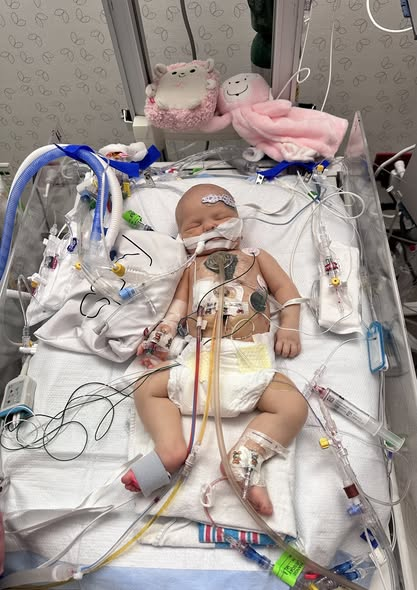
Her parents followed closely, hearts pounding, barely able to process everything. In the CICU, wires and tubes surrounded their newborn daughter. It was not the peaceful first meeting they had imagined, but it was life-saving. The staff spoke gently, explaining each step, but all her parents could do was hold her tiny hand through the wires and whisper promises:“We’re here, baby girl. You are not alone.”
The doctors explained that surgery was not optional. At just five days old, Vail would undergo open-heart surgery to repair her defects. Her parents struggled with the reality—how could someone so small endure something so enormous? Yet, they had no choice but to trust the team of surgeons who had trained for moments like this.
The night before surgery, the CICU was quiet except for the steady beeping of monitors. Her parents sat close, memorizing every detail of her face, brushing their fingers over her soft hair, whispering prayers into the silence. The thought of letting go, even for a moment, was unbearable.
When morning came, they walked beside the bed as nurses wheeled Vail toward the operating room. At the doors, they had to stop. Her parents leaned down, kissing her cheeks, whispering one last promise:“Be strong, our little warrior.” And then she was gone, beyond the double doors where only faith could follow.
The waiting was excruciating. Hours dragged by like days. They prayed, cried, and clung to each other, jumping every time the phone at the waiting desk rang. Finally, the surgeon emerged—Dr. Ashfaq, a man whose steady hands had repaired countless hearts. He explained that the surgery had gone as well as possible. The abnormal blood vessel had been repaired, and both the VSD and ASD were patched. Their little girl’s heart, though fragile, was now working the way it was meant to.
Tears of relief poured down their cheeks. Gratitude overwhelmed them—not just for the surgeon, but for every doctor, nurse, and technician who had poured their skill and compassion into saving their daughter.
Recovery was the next mountain to climb. The first days were hard. Vail’s small body fought to adjust, surrounded by tubes, IVs, and monitors. Her parents kept vigil at her bedside, cheering every small victory: a stable oxygen level, a steady heartbeat, a flicker of strength returning to her movements.
Nurses gently guided them on how to touch her, how to comfort her without disturbing the delicate balance of her recovery. They celebrated when she opened her eyes for longer, when she grasped a finger, when she showed signs of wanting to feed.
Day by day, their warrior girl grew stronger. And then, against all odds, just two weeks after surgery, the words they had barely dared to hope for came true:“She’s stable enough to go home.”

Walking out of Cincinnati Children’s with Vail bundled in their arms was nothing short of miraculous. The same hospital that had once felt overwhelming and terrifying had become the place that gave their daughter a future.
At home, things were different, but beautifully so. Each breath she took was a reminder of resilience. Each beat of her heart was proof of the miracle they had been given. Her scar, a delicate line across her chest, became a mark of courage—a story written on her body that spoke louder than words: “I survived. I am strong.”
Her parents remain profoundly grateful. They thank Dr. Ashfaq, the cardiologists, the CICU nurses, and every person who played a role in giving their daughter life. They thank family and friends who surrounded them with love and prayers when they felt they had none left to give. And above all, they thank Vail herself—for fighting so bravely, for showing them what true strength looks like.
Today, when they look at Vail, they don’t just see a baby who survived surgery. They see a miracle. They see a future once clouded by fear, now filled with hope. They see a heart once broken, now whole—stitched together by the hands of medicine, the power of prayer, and the unshakable love of a family who never gave up.
And they share her story, not only to celebrate her survival but to remind others walking through similar journeys: You are not alone. There is hope. Fragile hearts can be repaired. Miracles do happen.