
The Buff-Breasted Paradise Kingfisher (Tanysiptera sylvia), also known as the Buff-Breasted Kingfisher, is a striking and elegant bird renowned for its vibrant plumage and long tail streamers. It is a member of the tree kingfisher subfamily, which is distinct from the more commonly known river kingfishers.

Physical Description
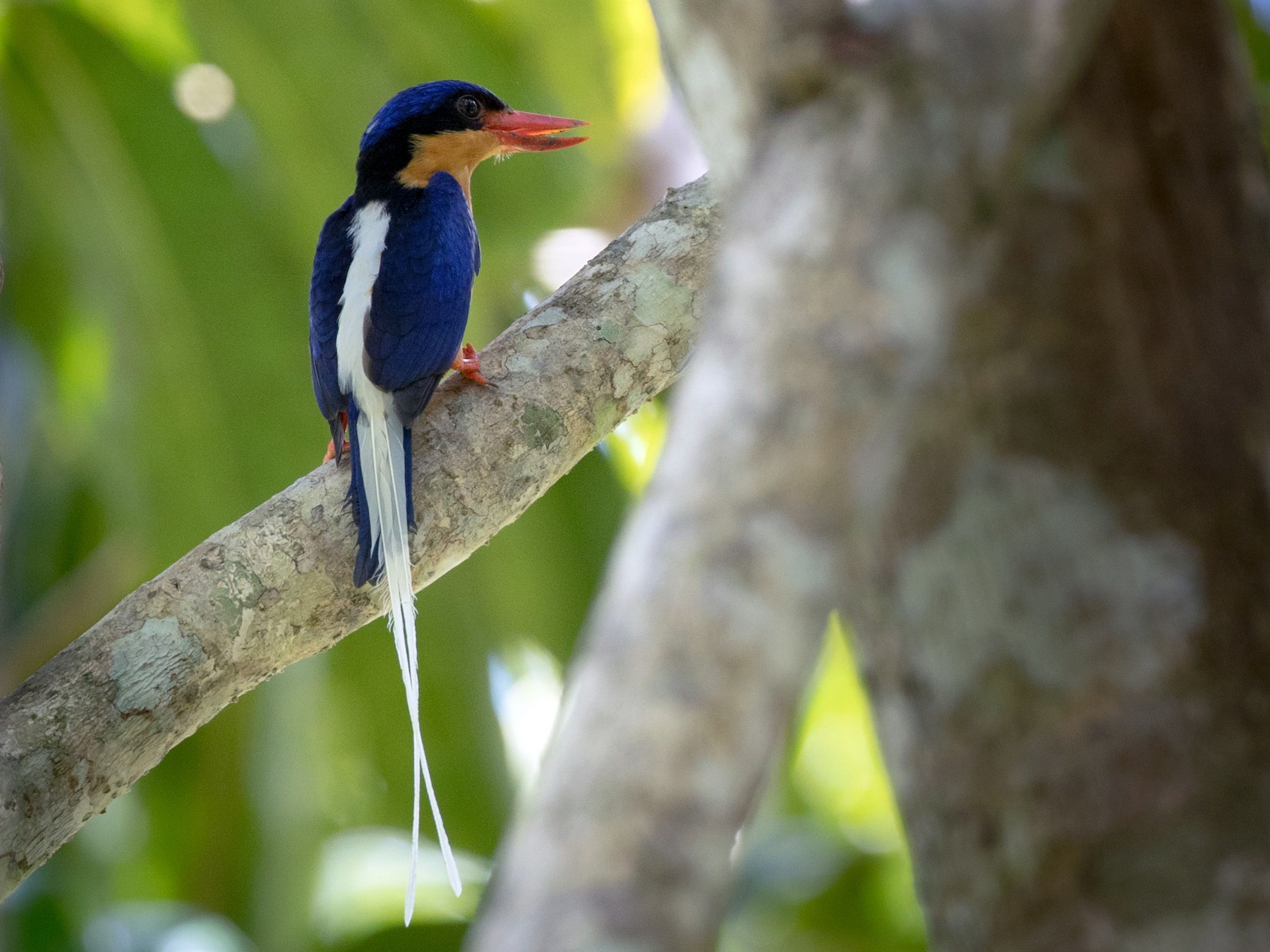
The Buff-Breasted Paradise Kingfisher is a medium-sized bird, approximately 33 cm (13 inches) in length, including its long tail feathers. It has a distinctive appearance with a bright blue back, wings, and tail. Its head and upper breast are a vibrant orange-buff color, which transitions into a white belly. One of its most notable features is the long, white, ribbon-like tail streamers, which can be as long as the bird’s body itself. Its bill is red, adding to its colorful appearance.
Habitat and Distribution
This kingfisher species is native to the lowland rainforests and monsoon forests of northern Queensland, Australia, and New Guinea. During the breeding season, it migrates to the coastal rainforests of northeastern Australia, particularly in the Cape York Peninsula. Outside the breeding season, it inhabits more inland forested areas and can also be found in secondary growth and plantations.

Behavior and Diet
The Buff-Breasted Paradise Kingfisher is an agile and adept hunter, feeding primarily on insects, small reptiles, and occasionally small mammals and amphibians. It hunts by perching quietly on a branch and then swiftly darting out to capture its prey. Despite its vibrant colors, it can be surprisingly difficult to spot in the dense rainforest foliage.
This kingfisher is known for its distinctive call, a loud, clear, and repetitive “tchip-tchip” sound, which is often heard during the breeding season.

Breeding and Lifespan
The breeding season for the Buff-Breasted Paradise Kingfisher occurs during the Australian summer, from November to April. It nests in termite mounds, either on the ground or in trees. Both the male and female take part in excavating a tunnel into the mound, where the female then lays a clutch of 2-4 eggs. The parents share the responsibility of incubating the eggs and feeding the chicks once they hatch.
The chicks fledge after about three weeks but continue to be fed by the parents for a short period until they are fully independent.

Conservation Status
The Buff-Breasted Paradise Kingfisher is listed as a species of Least Concern by the International Union for Conservation of Nature (IUCN). Its population is currently stable, and it benefits from a relatively wide distribution and adaptability to various forest habitats. However, it is still vulnerable to habitat destruction due to logging, agriculture, and development, which could impact its breeding and feeding grounds.

In conclusion, the Buff-Breasted Paradise Kingfisher is a beautiful and fascinating bird, celebrated for its dazzling colors and remarkable tail feathers. Its presence in the rainforests of Australia and New Guinea adds to the rich biodiversity of these regions, making it a favorite among birdwatchers and nature enthusiasts.
Video: