
The many-colored rush tyrant or many-coloured rush tyrant (Tachuris rubrigastra) is a small passerine bird of South America belonging to the tyrant flycatcher family, Tyrannidae. It is the only member of the genus Tachuris and is sometimes placed in a separate monotypic family. It inhabits marshland and reedbeds around lakes and rivers. It is particularly associated with stands of Scirpus. The nest is built among plant stems.

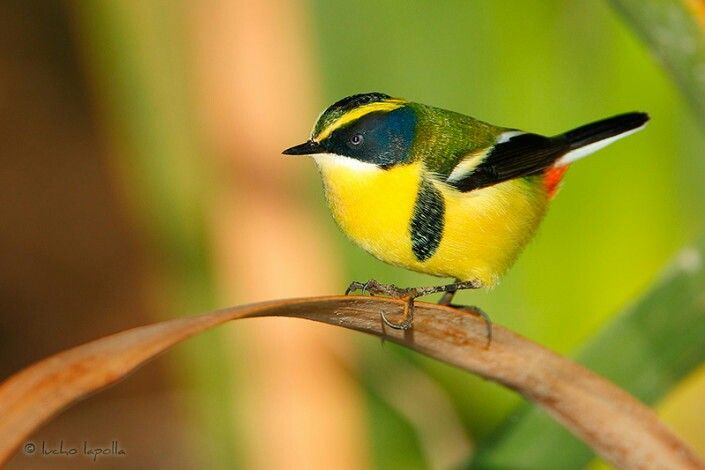
DESCRIPTION: The many-colored rush tyrant is a small bird, 11–11.5 cm (4.3–4.5 in) in length. As the bird’s name suggests, the plumage is very colourful. The back and rump are green while the underparts are yellow apart from the white throat, black breastband and red undertail-coverts. The face is dark blue-grey, there is a yellow stripe over the eye and the crown is dark with a red patch that is often concealed. The wings and tail are dark with a white wingbar and white outer tail-feathers. Females are duller than the males.

On the head, the centre of forehead and crown is black, and a red tuft appears when the bird raises its crest. Two conspicuous golden yellow stripes extend from the bill’s base to the nape. The head sides, including lores, orbital and auricular areas are blue-black, mostly dark blue towards the nape. The latter is ochraceous, turning green towards hindneck and back.The slender bill is black. The eyes are pale blue-grey. Long legs and strong feet are black, with yellow finger soles.
Both adults are similar, but the female is slightly smaller and duller than male.The juvenile has the green upperparts often scaled yellow. Breast and belly are paler yellow. There is no blue on head sides and the two breast bands are absent.

HABITAT: The Many-coloured Rush-Tyrant frequents marshy areas with thick reedbeds and rushes, and grassy areas at lake edges. This species can be seen from sea-level up to 4200 metres of elevation, but it rarely leaves its marshy habitat.It is common in reedbeds on the shores of high-elevation lakes in the Andes, and in the lowlands of Argentina.

CALLS AND SONGS: The Many-coloured Rush-Tyrant utters rapid series of insect-like notes “tic”. It also produces a whistle ending in a harsh note “piwup bzzzzt” and including other buzzing sounds.
The song is quite musical, a rich gurgled “treeutu-tu, treeutu-tu-tu-tu-tu”.

BEHAVIOUR IN THE WILD: The Many-coloured Rush-Tyrant is usually seen in pairs or groups. This species is tame and restless, always foraging actively in dense rushes. However, in spite of its brightly coloured plumage, it is often well concealed among the vegetation.It is an insect-eater, and takes insects, arthropods and other small invertebrates within the marshy vegetation or on the water surface.It often perches on vertical stems and glean preys from floating vegetation and reed edges. It can cling up to the reed stems or hang upside down. The flying preys are caught by sallying from a perch. It also hops and runs on the ground, in the mud and on the floating vegetation while searching for preys.
PROTECTION / THREATS / STATUS: The Many-coloured Rush-Tyrant has large range and the population is suspected to be stable. This species is locally common in its range, and can be found in loose, scattered colonies. It also occurs in several protected areas.Currently, the Many-coloured Rush-Tyrant is evaluated as Least Concern.
Video: