
Abbott’s booby (Papasula abbotti) is an endangered seabird of the sulid family, which includes gannets and boobies. It is a large booby and is placed within its own monotypic genus. It was first identified from a specimen collected by William Louis Abbott, who discovered it on Assumption Island in 1892.

Abbott’s booby breeds only in a few spots on the Australian territory of Christmas Island in the eastern Indian Ocean, although it formerly had a much wider range. It has white plumage with black markings, and is adapted for long-distance flight. It forages around Christmas Island, often around nutrient-rich oceanic upwellings, although individuals can travel for thousands of kilometres. Pairs mate for life and raise one chick every two or three years, nesting near the top of emergent trees in the rainforest canopy.

The population is decreasing. Historically, much of its former habitat was logged to make way for phosphate mining. Some logging continues, and the effects of the former logging continue to adversely affect the current population. Another threat has been caused by the introduction of yellow crazy ants, which decrease habitat quality. Minimal habitat declines have a significant effect on the bird population. All nesting areas have been included in a national park.

Description: Abbott’s booby is the largest of all booby species, and is adapted to long-distance flight. Individuals can reach 80 cm (31 in) from beak to tail and weigh about 1.5 kg (3.3 lb). It is distinguished from other sulids in the region by its black and white plumage; the only other bird with similar coloration and shape is the masked booby, which has an all-white body with black wings only. They have an off-white plumage, which contrasts with black eye patches, black wings and tails, and black flank marks. Their feet are blue and webbed, with black outer ends. Males have pale grey bills with a black tip, whereas females have pink bills with a black tip. Chicks have white down and a cape of black scapular feathers.
Juvenile birds have plumage similar to adults, unlike other species of boobies.

Distribution and habitat: Abbott’s booby is the only booby restricted to a single location, although its former distribution covered much of the Indian and Pacific Oceans.Fossil evidence indicates its former presence in the South Pacific, and eyewitness reports of it formerly breeding on the Mascarene Islands. In April 2007, an individual of this species was photographed at a booby colony on Rota in the Pacific Ocean, and the same individual has been seen off-and-on in the red-footed booby colony there through at least 2011.

It breeds in tall trees in the plateau forests of the central and western areas of Christmas Island, and in the upper terrace forests of the north coast.Nest distribution is patchy, based on topography, with the majority of nests in trees on uneven terrain. Nests are usually built on Syzygium nervosum and Planchonella nitida trees, although emergent Tristiropsis acutangula trees are sometimes used. Due to the trade winds flowing south-east from April to November, trees that can be approached from the northwest are favoured.
Its foraging range usually reaches 40–100 km (25–62 mi) from Christmas Island, although individuals are often seen in Indonesia and vagrants reach as far as mainland Australia. A single female was recently observed on Rota, northeast of Guam in the Pacific, and some records from the Banda Sea indicate either an even larger range or unknown breeding colonies.

Breeding: Courtship takes the form of a face-to-face display. Partners mate for life, and maintain the same nest site throughout their lives.Nests are made near the top of rainforest trees, 10–40 m (33–131 ft) off the ground, usually at elevations of 150 m (492 ft) or higher. Breeding cycles last 15–18 months, and only one egg is laid during each cycle. Successful pairs can nest once every two years, but often take rest years between attempts to raise a chick. These rest years are taken even if the couple is unsuccessful in raising their chick. Most pairs only breed once every three years.
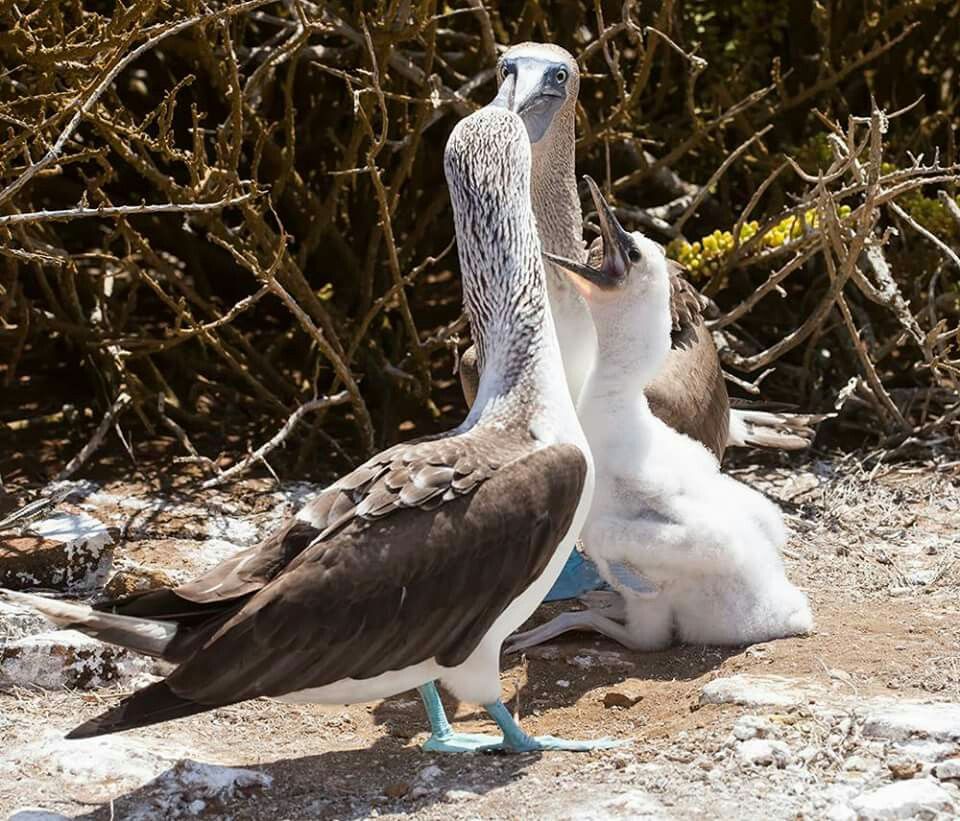
Mating usually takes place in April, and eggs are laid between April and July.Eggs are equal to 8% of the female’s body weight. They are incubated under the webbed feet of the parents, which become vascularised and warm. Incubation is undertaken by both parents, which take shifts of up to two days. Eggs are incubated for about 56 days, which is 30 days longer than in other sulids.Chicks hatch from June to November, after the eggs are incubated around 56 days.They take 170 days to fully fledge, and an additional 200 days to become fully independent.Most chicks make their first flight in December or January.Fledglings reach maturity around eight years of age, and can live up to 40 years.
Video: